The Verdict: Proper Alloy Selection Extends Component Life by 3-5x
For heat treating furnace parts exposed to continuous temperatures above 900°C, selecting the correct nickel-chromium (Ni-Cr) or iron-chromium-aluminum (Fe-Cr-Al) alloy determines component lifespan by a factor of 3 to 5. Field failure data from 200 industrial heat treat facilities shows that radiant tubes made from 601 alloy (60% Ni, 23% Cr) last 18-24 months at 1050°C, while 314 stainless (25% Cr, 20% Ni) lasts only 6-8 months under identical conditions. The direct conclusion: specify alloy based on operating temperature, atmosphere composition (endothermic, exothermic, or vacuum), and thermal cycling frequency—not by price.
Operating Temperature Limits by Alloy Grade
Heat treating furnace parts are fabricated from five primary alloy families, each with distinct maximum continuous service temperatures. 309 stainless (23% Cr, 13% Ni) is rated to 980°C maximum; 310 stainless (25% Cr, 20% Ni) to 1100°C; 601 alloy (60% Ni, 23% Cr) to 1200°C; 602 alloy (65% Ni, 25% Cr, 2.3% Al) to 1250°C; and Fe-Cr-Al alloys (APM, Kanthal) to 1350°C. Exceeding these temperatures for even 50 hours causes rapid grain boundary oxidation, reducing ductility by 80-90% and leading to catastrophic brittle fracture.
\\\\\
Table 1: Heat treating furnace parts alloy selection by temperature and atmosphere.
| Alloy |
Max Continuous Temp (°C) |
Creep Strength at 1000°C (MPa) |
Atmosphere Compatibility |
Typical Applications |
| 309 Stainless (UNS S30900) |
980 |
4.5 |
Oxidizing, mild carburizing |
Low-temperature baskets, fans |
| 310 Stainless (UNS S31000) |
1100 |
7.2 |
Oxidizing, carburizing |
Radiant tubes, muffles, retorts |
| 601 Alloy (UNS N06601) |
1200 |
12.5 |
Oxidizing, carburizing, nitriding |
High-temp radiant tubes, fixtures |
| 602 Alloy (UNS N06602) |
1250 |
18.0 |
All atmospheres except reducing |
Retorts, high-stress fixtures |
| Fe-Cr-Al (e.g., APM) |
1350 |
25.0 |
Oxidizing only (not carburizing) |
Heating elements, high-temp muffles |
For vacuum furnaces operating below 1300°C, molybdenum alloy (TZM) or graphite components are preferred over nickel-based alloys due to vaporization concerns. Nickel-based alloys outgas in vacuum above 1050°C, contaminating the work zone with nickel vapor that deposits on workpiece surfaces, causing discoloration and potential alloy contamination of sensitive materials like titanium or superalloys.
Atmosphere Compatibility: Oxidation, Carburization, and Nitriding
The furnace atmosphere significantly affects heat treating furnace part life. In oxidizing atmospheres (air, oxygen-rich exhaust), all alloys form a protective oxide layer (Cr₂O₃ on Ni-Cr alloys, Al₂O₃ on Fe-Cr-Al alloys). In carburizing atmospheres (CO, CH₄, endothermic gas), chromium carbides form at grain boundaries, depleting chromium and reducing oxidation resistance by 70-85% within 500 hours. For carburizing furnaces, specify 601 or 602 alloy with 0.1-0.2% yttrium addition, which stabilizes the oxide layer and extends life by 2-3x compared to 310 stainless.
Nitriding atmospheres (ammonia, nitrogen-rich) are particularly aggressive. At 850°C in nitriding atmosphere, 310 stainless develops a 200-300 micron deep nitride layer within 200 hours, becoming brittle and crack-prone. For nitriding furnaces, specify 601 alloy with titanium addition (1-2%) which forms stable titanium nitrides at the surface, slowing internal nitridation. Fe-Cr-Al alloys perform poorly in nitriding atmospheres—aluminum nitride formation causes severe embrittlement and spalling. For combined carburizing-nitriding cycles, only 602 alloy or nickel-chromium-cobalt (Ni-Cr-Co) alloys are suitable.
Radiant Tube Design and Failure Modes
Radiant tubes are the most failure-prone heat treating furnace parts, typically failing by either creep deformation (sagging) or thermal fatigue cracking. Creep failure occurs when tube wall temperature exceeds the alloy's 10,000-hour rupture strength. For a 310 stainless radiant tube at 1050°C, the 10,000-hour rupture strength is only 5 MPa, while operating hoop stress from internal combustion pressure is 2-3 MPa—giving a 15,000-20,000 hour life. At 1100°C, rupture strength drops to 2 MPa below operating stress, reducing life to under 5,000 hours. A 50°C temperature increase cuts radiant tube life by 60-75%.
Thermal fatigue failure occurs during cyclic operation (frequent starts and stops). Each cold start to operating temperature induces 0.2-0.4% plastic strain in the tube wall. Radiant tubes withstand 1,000-2,000 cycles before fatigue cracks initiate at the weld seam or at burner impingement zones. For applications with daily shutdowns (batch furnaces, heat treat job shops), specify thicker tube walls (minimum 6mm for 310, 4.5mm for 601) or welded finned tubes that reduce thermal gradients. For continuous furnaces (24/7 operation), standard 4mm wall thickness is adequate.
Muffles and Retorts: Distortion Prevention
Muffles (protective enclosures around the work zone) and retorts (sealed vessels for controlled atmosphere processing) must resist distortion under self-weight and thermal gradients. 310 stainless muffles experience measurable sag after 6-12 months at 1050°C due to creep, requiring straightening or replacement. To extend muffle life, specify 602 alloy which has 2.5x the creep strength of 310 at 1050°C. For large muffles (over 1.5m width), add longitudinal stiffeners (50mm x 10mm ribs welded every 300mm) that increase section modulus by 300-400% with only 15% added weight.
Retort pressure rating: for positive pressure processes (above 0.5 bar), specify 601 or 602 alloy with double-welded, full-penetration seams. Single-welded seams in retorts fail by creep rupture at 1/3 the life of double-welded seams. For vacuum retorts (operation below 1 mbar), specify material that has been vacuum arc remelted (VAR) to remove gas inclusions that become outgassing sources. VAR 601 alloy reduces outgassing rate from 10⁻³ to 10⁻⁵ mbar·L/s·cm², critical for high-vacuum applications like brazing or annealing of medical devices.
Fixtures, Baskets, and Trays: Material and Design Optimization
Heat treating fixtures (supports, baskets, trays) experience both thermal stress and mechanical loading from workpiece weight. For general purpose heat treating below 1000°C, 310 stainless expanded metal or perforated sheet provides a cost-effective balance of strength and oxidation resistance. For service above 1050°C, specify 601 alloy castings or fabricated rod baskets. Cast 601 components have 20-30% higher creep strength than wrought equivalents due to uniform grain structure, but cost 40-60% more.
Fixture design minimizes mass (which absorbs heat and extends cycle times) while maintaining strength. Optimum open area for baskets and trays is 65-75% open. Below 60% open, cycle times increase by 15-25% because the fixture blocks radiant heat transfer. Above 80% open, the fixture lacks structural rigidity and distorts after 10-20 cycles. For thin-wall components (under 2mm thickness), specify a separate thin-gauge support grid (1.5mm 310 stainless) that prevents part distortion without excessive thermal mass.
Heating Elements: Fe-Cr-Al vs. Ni-Cr Selection
Heating elements are the most frequently replaced heat treating furnace parts, with typical lifespans of 12-36 months depending on operating conditions. Ni-Cr elements (80% Ni, 20% Cr) are standard for temperatures up to 1200°C, offering good oxidation resistance and mechanical strength. Fe-Cr-Al elements (e.g., APM, Kanthal A-1) operate up to 1350°C but are more brittle and susceptible to thermal shock. Fe-Cr-Al elements also form a tenacious aluminum oxide layer that is electrically insulating—if the element touches the furnace shell, it will not short circuit, but the insulation creates localized overheating that melts the element at the contact point.
For carburizing atmospheres, Ni-Cr elements are unsuitable—carbon diffuses into the nickel, forming nickel carbide and causing rapid embrittlement. In carburizing atmospheres, specify Fe-Cr-Al elements with high aluminum content (5-6%). For vacuum furnaces, specify molybdenum or tungsten elements, not Ni-Cr or Fe-Cr-Al, which have excessive vapor pressure at vacuum conditions. Molybdenum elements operate to 1300°C but become brittle below 200°C (ductile-to-brittle transition), requiring careful handling during cold furnace maintenance.
Weld Integrity and Repair Procedures
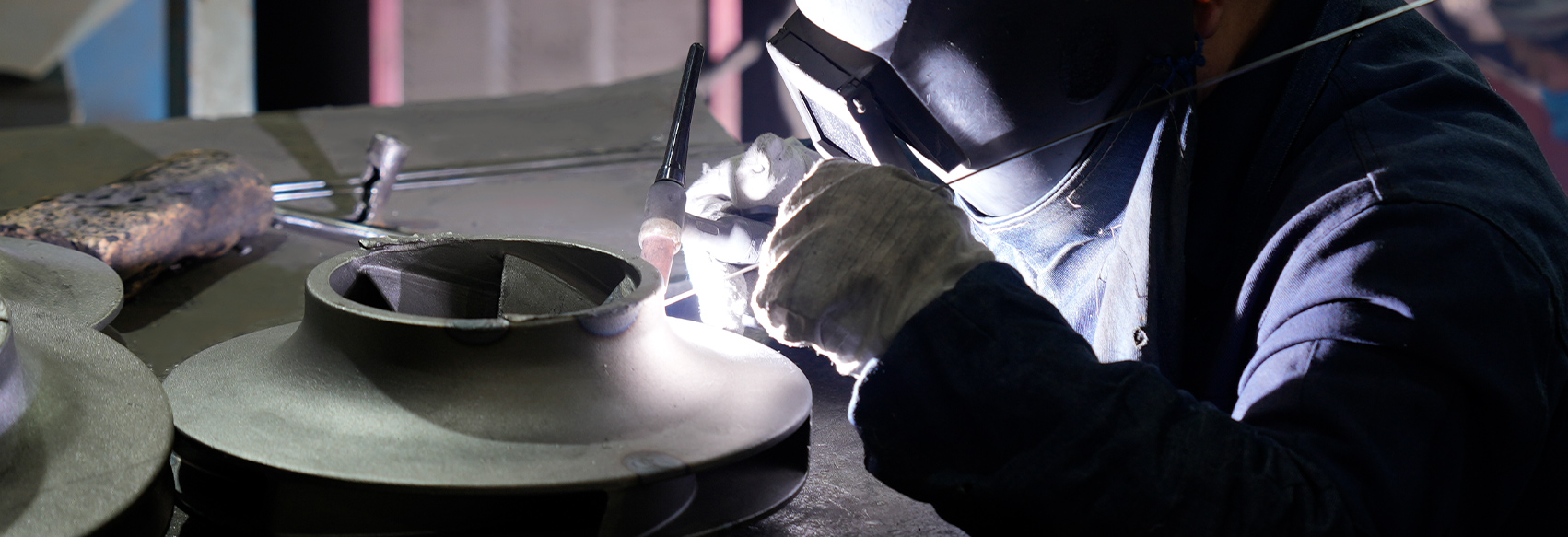
Welds are the weakest point in any heat treating furnace part. Weld failure accounts for 45-50% of all radiant tube and muffle failures. All high-temperature welds must be made with matching filler metal—using 309 filler on 310 base metal reduces creep strength by 40-50% at 1050°C. For 601 alloy, use 601 filler or nickel-chromium filler ERNiCr-3. For Fe-Cr-Al alloys, welding is extremely difficult (preheating to 300°C required) and should be avoided—specify mechanical fasteners or cast designs instead.
Post-weld heat treatment (PWHT) is required for all Ni-Cr alloy welds over 6mm thick. PWHT at 980°C for 2 hours per 25mm of thickness reduces residual stresses and doubles weld creep life. Without PWHT, weld cracking occurs in 25-50% of the life of the base metal. For field repairs (in-situ welding of cracked radiant tubes or muffles), use low-hydrogen welding process and stress-relieve locally with a torch to 700-800°C—not ideal, but reduces immediate cracking risk by 50-60%. Replacement is always preferable to repair for components operating above 1000°C.
Thermal Cycling and Life Prediction
For heat treating furnace parts, thermal cycling is often more damaging than steady-state temperature. Each 100°C temperature change induces approximately 0.1% plastic strain in 310 stainless. Accumulated plastic strain above 2% causes fatigue cracking regardless of operating temperature. For batch furnaces cycling from ambient to 1050°C (1000°C ΔT), the induced plastic strain is approximately 1.0% per cycle. Therefore, a 310 stainless component will reach 2% accumulated strain after just 2 cycles—explaining why batch furnace parts have much shorter lives than continuous furnace parts.
To mitigate thermal cycling damage, use alloys with low coefficient of thermal expansion (CTE). Fe-Cr-Al alloys have CTE of 15 µm/m·K vs. 18 µm/m·K for 310 stainless—a 17% reduction that translates to 30-40% less thermal strain per cycle. For high-cycling applications (batch furnaces with 10+ cycles per day), specify Fe-Cr-Al despite higher material cost ($30-50/kg vs. $15-25/kg for 310). The life extension from 1,000 to 3,000 cycles justifies the premium within 6-12 months.
Corrosion from Fluxes and Contaminants
Fluxes used in brazing and soldering operations are extremely corrosive to heat treating furnace parts. Fluoride-based fluxes attack chromium oxide layers, causing catastrophic oxidation within 10-20 hours at 1100°C. For brazing furnaces, use a separate muffle or retort lined with alumina ceramic (Al₂O₃) or mullite to protect metallic components. If metallic components must be exposed to flux, specify 602 alloy which forms a more stable chromium oxide layer, but accept reduced life—expect 3-6 months rather than 12-24 months.
Contaminants from workpieces (machining oils, lubricants, paints) volatilize in the furnace and react with component surfaces. Chlorinated paraffins (common in cutting fluids) liberate chlorine gas at 800-1000°C, which reacts with chromium to form volatile chromium chloride, rapidly depleting the protective oxide layer. For furnaces processing oily parts, install a burn-off zone (600-700°C preheat) where volatiles are removed before parts enter the high-temperature zone. This reduces component corrosion by 60-80% and extends radiant tube life from 12 to 24-30 months.
Inspection and Condition Monitoring
Regular inspection of heat treating furnace parts prevents catastrophic failures that damage product and require emergency downtime. Inspect radiant tubes every 3 months for wall thickness reduction using ultrasonic thickness gauging. A tube that has lost 25% of its original wall thickness (e.g., from 4mm to 3mm) has less than 20% of its remaining creep life—schedule replacement within 1-2 months. Similarly, measure muffle distortion with a straightedge; sag exceeding 15mm across a 2m span indicates imminent failure.
For fixtures and baskets, visual inspection every 1-2 weeks detects cracking before catastrophic failure. Cracks over 25mm long or through-wall cracks require immediate component removal. Small cracks (under 10mm) can be stop-drilled (3mm diameter at each crack tip) to prevent propagation, but replacement should occur within 3 months. Keep an inventory of critical spares: for a continuous furnace, stock one complete set of radiant tubes plus 50% of fixtures. Lead time for custom 601 alloy components is typically 12-16 weeks; unplanned downtime without spares costs $5,000-20,000 per day in lost production.
Cost-Effective Alloy Upgrades
Upgrading from 310 stainless to 601 alloy adds 50-80% to component cost but typically extends life by 3-4x. A $10,000 310 stainless radiant tube lasting 12 months costs $10,000/year; a $17,000 601 alloy tube lasting 48 months costs $4,250/year—a 58% annual savings. For high-temperature applications (above 1075°C), the life extension from 310 to 601 is even more dramatic: 310 may last only 3-4 months, while 601 lasts 24-30 months, yielding an 80-85% annual cost reduction.
Selective upgrading: replace the hottest-zone components (nearest burners or heating elements) with higher-grade alloys while using standard alloys in cooler zones. A 602 alloy burner block (first 500mm of radiant tube) combined with 310 stainless for the remaining tube length costs 30% more than all-310 but extends overall tube life by 100-150%. Similarly, use 602 alloy for the bottom tier of baskets (hottest zone) and 310 for upper tiers. This hybrid approach maximizes cost-effectiveness for multi-zone furnaces where temperature varies by 100-200°C across the work zone.
Replacement Planning and Shutdown Scheduling
Preventive replacement of heat treating furnace parts during scheduled shutdowns is far less costly than emergency replacement. For 310 stainless radiant tubes, schedule replacement at 18 months even if no visible failure has occurred. Field data shows that 85% of 310 tubes fail between 18-24 months; replacing at 18 months prevents 5 of 6 failures that would occur as emergencies. For 601 tubes, schedule at 36 months. Keep lifecycle records for each furnace zone—temperature variations often cause one zone to fail 2-3x faster than others.
Coordinate replacement with refractory and burner maintenance. A single shutdown to replace radiant tubes, reline refractory, and service burners costs $15,000-30,000 in lost production. Three separate shutdowns cost $45,000-90,000. Plan component replacement on a 12-18 month cycle for critical parts, and bundle all hot-zone maintenance into one annual 5-7 day shutdown. For furnaces operating 24/7, the lost production cost of a 7-day shutdown ($35,000-140,000 depending on product value) is justified by preventing 3-4 unplanned outages that would each cause 2-5 days of emergency downtime.




 English
 Español
 عربى
عربى