Every heat treatment shop knows the disappointment: a new alloy work tray looks perfect when it is installed, then develops hairline cracks after a few hundred cycles between the hot zone and the charge. The failure is rarely a defect in the foundry's pour. More often, the alloy was chosen for temperature alone, while the real killer was the combination of oxidation, creep, and thermal shock the casting saw in service. Heat resistant steel casting is the practice of matching a high-temperature alloy, a casting process, and a component shape to the exact conditions inside the furnace. When the match is correct, the part runs for years; when it is not, the replacement cost quickly exceeds the initial saving.
This guide covers the grades that matter, the production routes that make them useful, the applications where they pay back, and the information you should put in an enquiry. The goal is practical: help you buy a casting that does not fail one year early.
What makes a casting heat resistant
Above roughly 800°C the meaning of strength changes. A part can keep its shape yet lose metal to rapid scaling, or keep its surface yet sag slowly under its own load. Two properties therefore define a heat resistant steel casting: oxidation resistance and creep resistance. Chromium provides the first, by forming a dense oxide scale that slows further attack. Nickel provides the second, by holding the austenitic structure that retains strength at red heat. Silicon improves the scale's adhesion; niobium and tungsten add high-temperature strength through stable carbides. Pull any of these levers too low and the service ceiling drops.
The EN grades listed below reflect this balance, and the practical difference between them matters more than the labels suggest.
Table 1: Common heat resistant steel casting grades and their practical service ceilings. The temperature figures are continuous-service values; cyclic loads reduce them.
Grade
Designation
Key chemistry
Continuous service ceiling
Typical cast parts
1.4848
GX40CrNiSi25-20
25Cr-20Ni-Si
~1050°C
Work trays, charge frames, recuperator parts
1.4852
GX40NiCrSiNb35-26
26Cr-35Ni + Nb
~1100°C
Radiant tubes, hearth rollers
HP type
26Cr35Ni (+Nb)
26Cr-35Ni
~1100°C
Agitators, high-load fixtures
2.4879
GNiCr28W
Ni-Cr-W
~1150°C
Furnace rollers, heating tubes
The temperature ceiling is only one part of the picture. A 1.4848 tray that runs at 950°C in a clean oxidizing atmosphere may last many seasons, while the same grade in a carburizing atmosphere with intermittent oil-quench loading can fail within months. That is why a serious supplier asks about furnace atmosphere and cycle pattern, not just the maximum temperature.
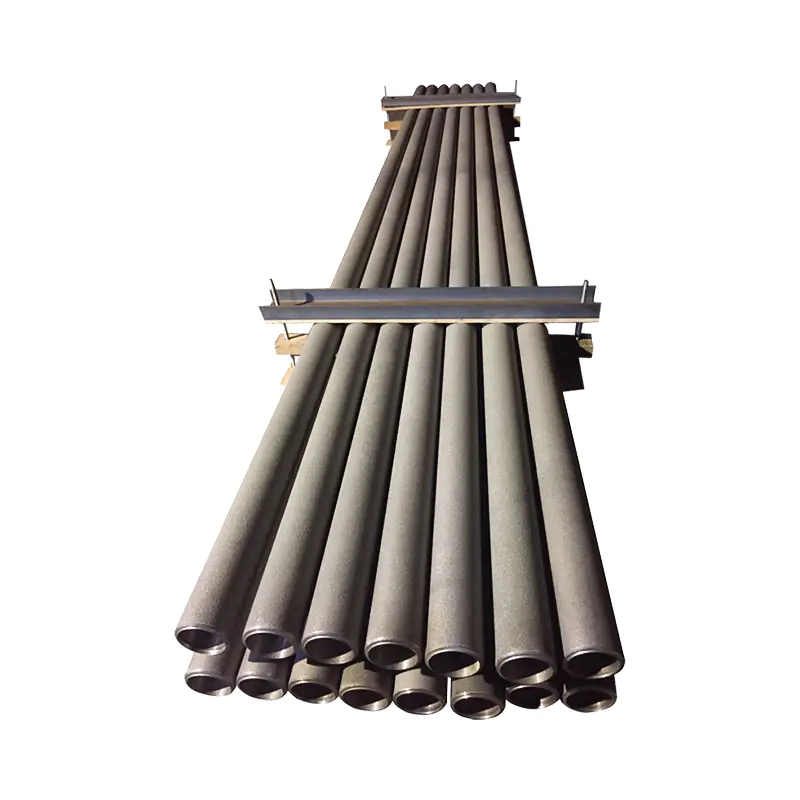
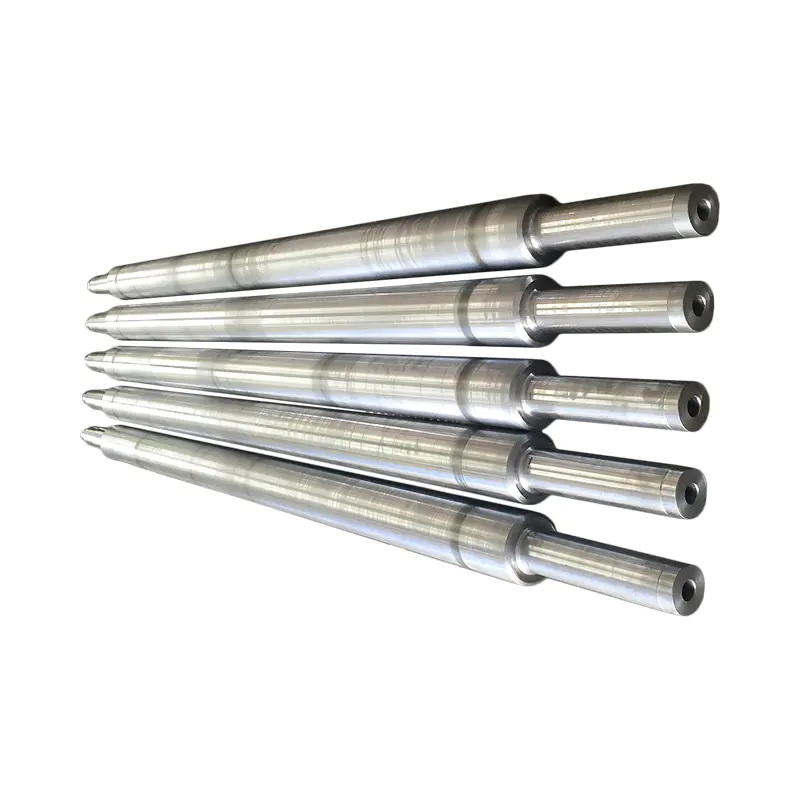
When a radiant tube has to carry higher creep loads, the usual choice is the 1.4852 grade, centrifugally cast and machined to exact outside dimensions. A closer look at the alloy families is described in our guide to the performance classification of heat resistant steel.
Once the grade is fixed, the casting method decides what you can actually make and how consistently. Centrifugal casting is the first choice for tubes and other axisymmetric parts such as radiant tubes, furnace rollers, and sleeves. Spinning the mould while the metal solidifies produces a dense wall with few shrinkage pores. Investment casting uses a wax pattern and ceramic shell to reproduce complex geometries such as baskets, hooks, and trays with thin ribs, close to final dimensions. Resin sand casting handles larger, heavier frames and one-piece structures where machining allowance is less critical.
The process choice is a cost and performance trade-off, not a question of which route is better.
Table 2: How the main casting processes differ for heat resistant steel parts.
Process
Best geometry
Surface finish
Dimensional tolerance
Typical batch
Centrifugal
Hollow and axisymmetric parts
Smooth on outside diameter
Close, especially after machining
Medium to high volume
Investment
Complex and thin-wall shapes
Fine surface detail
Close as-cast
Small to medium volume
Resin sand
Large and heavy frames
Coarse
Wide allowance
One-off or low volume
The practical rule is simple: if the part is a round tube or roll, specify centrifugal casting; if it is a lattice tray or bracket with thin sections, specify investment casting; if it is a massive furnace frame, resin sand casting is usually the economic answer. The same 1.4848 alloy can be produced by all three routes, yet the price per kilogram and the service life differ considerably.
Long radiant tubes and furnace rollers are typically supplied from centrifugally cast heat resistant steel pipe, where the controlled grain structure and machined outside diameter keep the part straight under load.
Heat treatment equipment is the biggest single application. Work trays, charge frames, pit furnace fixtures, and jigs are cycled repeatedly between high temperature and quench media, so they need both hot strength and resistance to thermal fatigue. Radiant tubes and furnace rollers carry the same demands with the added requirement of long, straight cylindrical geometry. The duty conditions for this sector are described on our heat treatment industry page, which lists the typical furnace components and their material expectations.
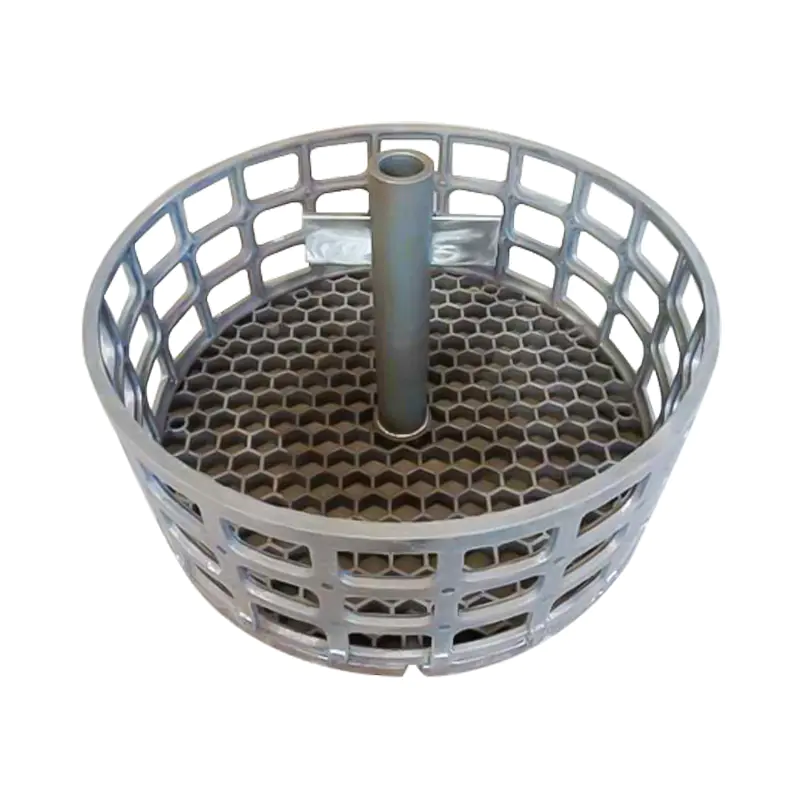
A typical 1.4848 heat treatment frame is cast with thin ribs that allow fast heating without sacrificing rigidity under the charge weight.
Beyond heat treatment, steel mills use hearth rollers and radiant tubes in walking-beam and roller-hearth furnaces, where scale and thermal cycling are constant. Chemical processors buy cast sleeves, recuperators, and agitators that must survive both heat and corrosive media. Waste-to-energy plants add grate bars and castings that combine abrasion and heat resistance. In every case, the specification starts with the same two questions: what temperature does the metal actually reach, and how often does it cycle?
When you send an enquiry, include the maximum continuous service temperature, the furnace atmosphere (oxidizing, reducing, or carburizing), the load the part carries, the thermal cycle pattern, a drawing with tolerances and machining allowance, and the required inspection level. A foundry that asks these questions is showing discipline; a foundry that quotes from temperature alone is taking a risk with your money.
What to verify before placing an order
Heat resistant steel castings cannot be upgraded by a simple heat treatment to compensate for a wrong alloy, so the chemistry must be right from the start. Ask for a spectrochemical analysis per heat, not just a material certificate copied from raw stock. Verification of the actual chromium and nickel content before shipment prevents the most expensive kind of field failure: one that is discovered after the furnace is assembled.
Inspect the process side as well. The casting defects that matter in high-temperature service are hot tears, misruns, and internal shrinkage. Thin ribs on a tray that look acceptable for a static part can become crack initiation points under cyclic heat. Check the foundry's inspection hardware, its in-house machining capacity, and the tolerances it can hold.
Confirm the exact grade and the standard used for verification.
Request a chemical composition report for each heat.
State whether the part will face liquid quench contact or clean radiant heat.
Specify non-destructive examination only where the safety case for the part demands it.
Examine the cast surface on every thin section and change of section.
Agree on machining allowances before tooling is made, not after the part arrives.
The difference between a 9,000-hour casting and an 18,000-hour casting is usually not luck. It comes from selecting a grade whose oxidation and creep limits match the duty cycle, choosing a casting process that suits the geometry, and verifying that the foundry delivers the chemistry and soundness it quoted. None of these steps is complicated, but together they separate a reliable furnace component from an expensive replacement.
Core principle: non-condensing temperature control technology ensures efficient cooling without condensation
1.4848 (GX40CrNiSi25-20) water-cooled furnace rollers, also known as "water-cooled rollers"...
Reasonable configuration of heat treating furnace parts from the perspective of process adaptation
Match the material properties of accessories according to the type of heat treatment
There are many t...
Introduction to Stainless Steel Cast Pipes and Cast Iron Pipes
In the industrial piping world, two of the most commonly used materials are stainless steel cast pipes and cast iron pipes. Both material...
Importance of Heat-resistant steel pipe
Material requirements in high temperature environments
In modern industry, the performance of materials directly determines the safety and efficiency of equipme...




 English
 Español
 عربى