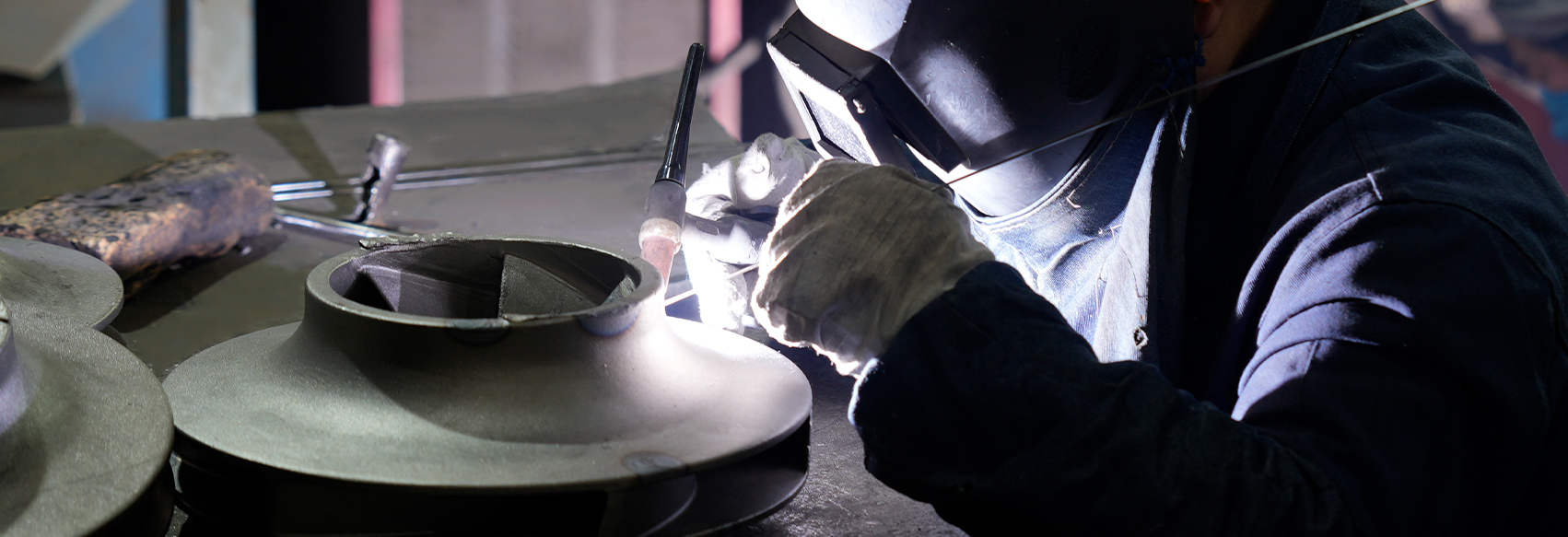
Twelve radiant tubes: 168 mm outside diameter, 12 mm wall, 2,400 mm long, grade 1.4848. The drawing looks simple. The purchasing question is not. For a hollow body of revolution, centrifugal casting is usually the cheapest route to a dense wall with no core and no riser — but only when the wall is uniform, the bore allowance is right, and the metal is spun at the correct speed. Miss one of those and the cost per finished tube doubles at the lathe.
What follows is how the process behaves in production, where it beats other routes, and what belongs on the purchase order.
What a Spinning Mould Does to Solidifying Metal
Molten metal is poured into a steel mould rotating at several hundred to more than a thousand revolutions per minute, depending on diameter. The resulting centrifugal force — quoted as a G-number, the multiple of gravity at the mould wall — presses the liquid against the mould surface and holds it there until it freezes.
That one mechanical fact drives everything else. Solidification starts at the outside and moves inward, so shrinkage voids, gas, and non-metallic inclusions are pushed toward the bore, which is later machined away. The finished wall is dense and fine-grained where it carries load; the bore is deliberately rough and oversized.
Two consequences matter commercially. There is no core to make or remove and no riser feeding a hidden hot spot, so metal yield is high — frequently above 90% of poured weight becomes part, against 50–65% for a risered sand casting. And the process cannot be faked: a mould spun too slowly or a pour run too cold leaves cold laps and entrained slag that appear as machining breakout, not as a cosmetic surface defect.
Three Variants, Three Different Part Families
The term covers three arrangements, and quoting "centrifugal casting" without naming which one is a reliable way to compare two prices that were never comparable.
Table 1: The three centrifugal arrangements differ mainly in mould axis and in how the bore or cavity is formed.
| Variant |
Mould axis |
How the bore forms |
Typical parts |
| True centrifugal |
Horizontal |
Free surface; rough bore, later machined |
Tubes, rolls, sleeves, cylinder liners, radiant tubes |
| Semi-centrifugal |
Vertical |
Central core, sand or metal |
Wheels, sheaves, gear blanks, flanged hubs |
| Centrifuging |
Vertical |
Cores in cavities around a central sprue |
Small non-symmetric parts, bushing sets, ring blanks |
For furnace hardware — radiant tubes, hearth rolls, sink rolls, protective sleeves — only the first row applies. The other two earn their place when a part has a bore but is not a plain tube.
Where Centrifugal Casting Pays Off, and Where It Stops Making Sense
The sweet spot is a body of revolution with a length-to-diameter ratio between roughly 1:1 and 15:1, a wall from about 4 mm to 150 mm, and an outside diameter inside the foundry's spinning window. Specialty shops commonly run 50 mm to 1,000 mm outside diameter and lengths up to 4,000 mm. Below 50 mm the pour and the bore cleaning get awkward; above roughly 1,000 mm, mould balance, speed control, and coating life become the constraints.
Typical maximum as-cast outside diameter by process (mm, indicative)
Static sand casting3,000
Centrifugal casting1,000
Investment casting500
The chart is indicative rather than a rule: static sand casting reaches the largest diameters because rotation is not part of the setup, while investment casting stays small because shell cost scales with surface area.
The route loses on anything boxy. Off-axis bosses, square flanges, internal ribs, and multiple ports need sand cores, which erode the cost advantage and reintroduce core-related scrap. Very short rings are also a poor fit, because the boring pass that removes the inclusion-rich inner layer can cost more than the casting itself. Walls under about 4 mm are hard to fill evenly when metal is being thrown outward.
Tubes, rolls, and sleeves that fall inside those limits are the everyday work of the heat-resistant pipe range.
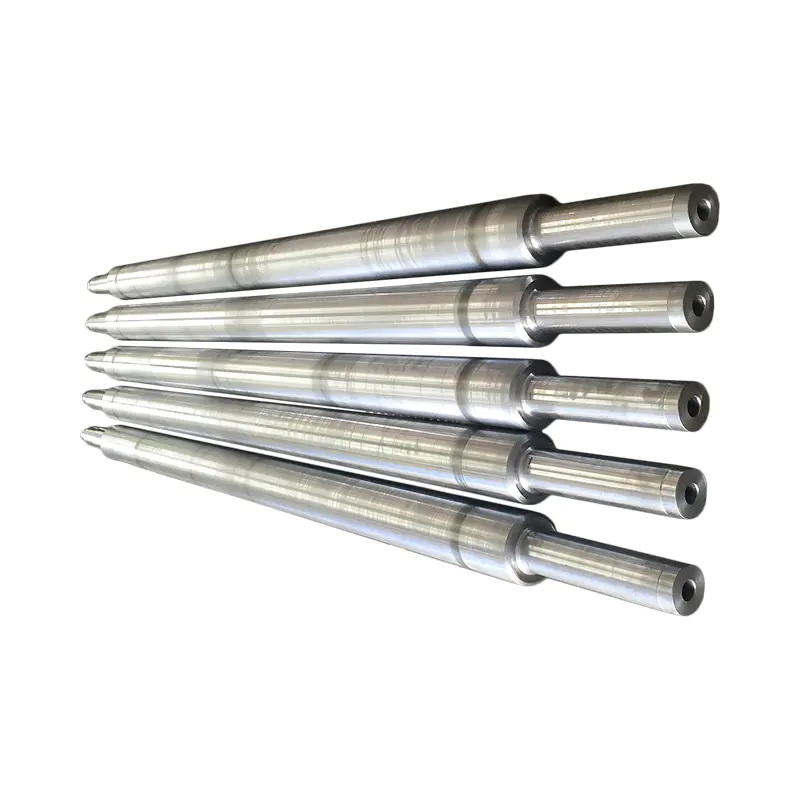 Centrifugal Cast Heat-Resistant Steel Pipe RangeBrowse the heat-resistant pipe range for tubes, rolls and sleeves, with grades such as 1.4848, 1.4852 and 2.4879 for furnace and radiant-tube duties.View Product →
Specifying the Casting: Tolerances, Structure, and Test Scope
Tolerances that actually get quoted
As-cast outside diameter typically holds ±1% or ±1.5 mm, whichever is greater. Wall thickness is the tolerance that drives machining cost: ±10% is common, and eccentricity — the difference between the thickest and thinnest wall in one section — is what causes breakout on one side of a tube while the other side cleans up with metal to spare. Ask for eccentricity separately, in millimetres, and for straightness in mm per metre, usually 1–2 mm/m.
A centrifugal casting is a cast structure, not a wrought one. Heat-resistant grades such as 1.4848 (GX40CrNiSi25-20) and 1.4852 (GX40NiCrSiNb35-26) solidify with a coarse dendritic network and intergranular carbides; the solution anneal and the cooling rate after it decide whether those carbides form a continuous brittle film or a dispersed strengthening phase. Duplex 2205 (CD3MN) is normally specified with 40–60% ferrite, which is a casting and cooling control issue rather than a line item you can assume.
Tests worth naming on the order
- Chemical analysis per heat by direct-reading spectrometer, with the heat number printed on the certificate.
- Metallography on a coupon or sacrificial extension for carbide morphology, or ferrite content on duplex grades.
- Dimensional check of wall eccentricity and straightness, by calliper plus 3D scanning or laser measurement on long tubes.
- Hydrostatic or pressure testing where the part forms a containment boundary; penetrant or ultrasonic inspection for rolls and sleeves.
- Hardness survey on the working face rather than the riser end for wear grades such as 440C or GX280 (KMTBCr26).
Matching Alloy to Temperature, Media, and Abrasion
Alloy choice usually decides more about service life than the casting route does, and it falls into three families with very different behaviour.
- Heat-resistant: 1.4848 for furnace furniture and radiant tubes in oxidizing service; 1.4852 with niobium for better creep resistance under thermal cycling; 2.4879 (GNiCr28W) and HP-type 26Cr35Ni for carburizing or reducing atmospheres at the top of the temperature range.
- Corrosion-resistant: 316L (CF3M) as the general-purpose austenitic option, and 2205 (CD3MN) duplex where chloride stress corrosion and higher strength both matter.
- Wear-resistant: 440C for hardness-driven grinding and knife work; high-chromium white iron such as GX280 (KMTBCr26) for mining casings and mill internals where abrasion dominates.
Heat-treatment furnace builders are the largest single user of the first family, because every continuous furnace needs rollers, radiant tubes, trays, and frames that survive years of cycling without bowing. The heat-treatment industry overview shows how those parts are normally specified.
Corrosion work is where centrifugally cast sleeves earn their keep. A 2205 or 316L sleeve spun as one piece has no weld seam to become a preferential attack path in a chloride environment, and the dense outer wall gives a predictable corrosion allowance.
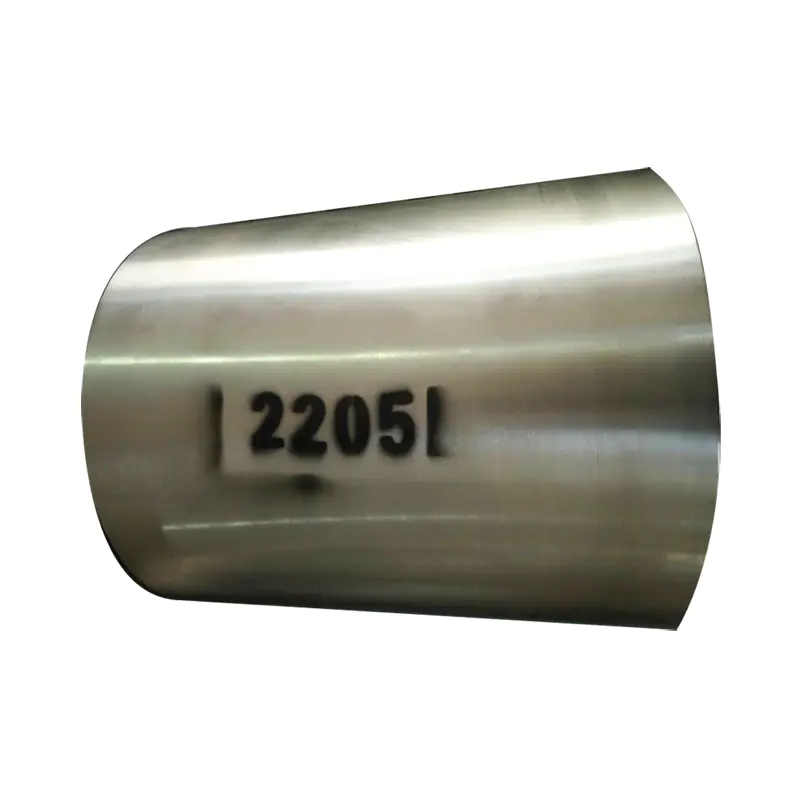 Centrifugal Cast Stainless Steel Pipe SleevesView 2205 and 316L stainless steel centrifugal cast pipe sleeves for corrosion duty, where a dense, seam-free sleeve helps resist chloride attack.View Product →
Abrasion duty is different again. Wear is a surface phenomenon, so what counts is hardness at the working face and the absence of shrinkage porosity that would let a particle undercut the matrix — both of which the outward-freezing wall of a centrifugal casting delivers more consistently than a static casting of the same alloy.
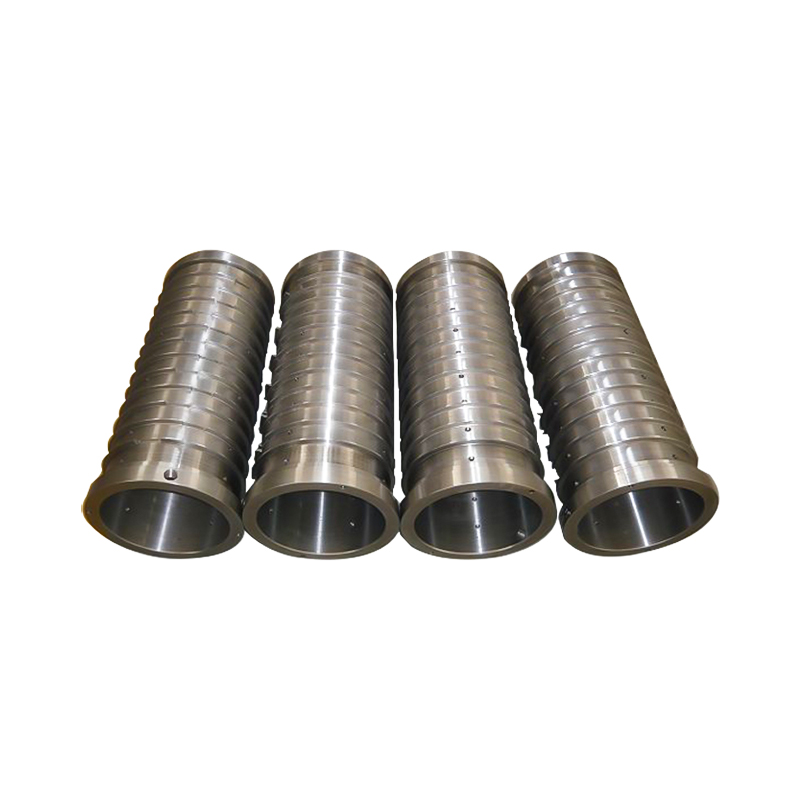 Centrifugal Cast Wear-Resistant Steel Pipe ProductsReview 440C and GX280 (KMTBCr26) wear-resistant inner cylinders and mining casing for abrasion duty, where surface hardness and sound walls matter.View Product →
Questions That Separate a Real Foundry from a Broker
Centrifugal castings are easy to buy badly, because the failure mode is invisible at goods-in: a wall that is 1.5 mm eccentric passes a calliper check at the ends and fails at the lathe three weeks later.
- What is the largest diameter and the longest length you spin in-house, and on which machine?
- How is the G-number controlled along a long mould, and what is your mould coating practice?
- Do you machine the bore yourself, and what bore allowance do you recommend for my finished wall?
- Which post-cast heat treatment is applied, and is it done in-house with recorded curves?
- Can you show heat-number traceability from ingot to finished part?
A supplier that spins 50 mm to 1,000 mm diameters up to 4,000 mm long, runs centrifugal, precision, and resin-sand routes under one roof, and machines in-house answers those questions with records rather than assurances. If the fundamentals are new to you, this explanation of the process and its characteristics is a useful primer before a supplier visit.
The decision rule is short. If the part is a hollow cylinder with a length-to-diameter ratio under about 15 and a wall above 4 mm, centrifugal casting gives the soundest wall at the lowest finished cost — provided the drawing states wall eccentricity, the alloy is annealed to a defined structure, and the certificate carries the tests you actually need. If it has square flanges, off-axis ports, or a wall thin enough to ripple, price it as a sand or investment casting and save yourself the argument at first article.




 English
 Español
 عربى