A desuperheater sleeve pulled from a scrubber circuit after nine months showed pitting through 6 mm of wall on the leeward side while the flow side stayed clean. The part had been cast in CF3M, the liquid carried chlorides at around 60 °C, and the dead leg never saw a fresh sweep of fluid. Re-cast in CD3MN duplex with a drain hole at the low point, the same component ran past four years. The foundry work did not change. The alloy choice and the geometry did.
Most stainless steel casting problems are decided before a pattern is cut. A grade gets carried over from a previous supplier, a previous plant or a previous decade, and nobody re-checks it against the damage the part actually sees. The sequence below is the one that keeps projects out of trouble: damage mechanism first, casting route second, wall thickness and machining stock third, and price last. Price follows those decisions; it should not lead them.
Match the Alloy to the Damage Mechanism, Not the Grade Name
Stainless grades are not ranked on a single scale. A casting that gives ten years in a nitric acid line can pit through in a chloride settling tank within a year, and a grade with excellent corrosion figures can be the wrong answer for a part being abraded by slurry at 400 °C. Four damage families cover most enquiries we see:
- Uniform wastage across the whole wetted surface. Dilute acids and hot caustic service usually fall here, and standard austenitic grades such as CF8 and CF3M, the cast equivalents of 304 and 316L, handle it well.
- Pitting and crevice attack under deposits, gaskets, sleeves and stagnant legs. Molybdenum and nitrogen carry the load, which is why duplex grades earn their premium in these positions.
- Erosion-corrosion and abrasion, where hardness matters more than chromium content. Martensitic grades such as 440C, and high-chrome alloys such as GX280 (KMTBCr26), are built for this duty.
- High-temperature oxidation and creep, where nickel and chromium content plus a stable microstructure decide life. Grades such as 1.4848 (25Cr/20Ni) and 1.4852 (35Ni/26Cr with niobium) belong to this group.
For the pitting family, one number does most of the screening work. The pitting resistance equivalent number, PREN, is chromium plus 3.3 times molybdenum plus 16 times nitrogen, all expressed in weight percent. It is a screening tool rather than a guarantee, but it separates grades quickly and explains a large share of field failures.
CF8 (304 type)18-19
CF8M / CF3M (316L)24-26
CD3MN (2205)34-36
440C (martensitic)17-18
Typical PREN values for common cast stainless grades. Higher resists chloride pitting better, but hardness and high-temperature strength are measured on entirely different scales.
The 316L casting that pitted was not a defective casting. It was a CF3M part doing a job that needed roughly ten PREN points more, and no amount of radiographic inspection would have revealed that mismatch. In chemical processing plants, where the same question appears at every sleeve, dip tube and agitator, moving one step up the duplex ladder is usually cheaper than adding maintenance cycles to the schedule.
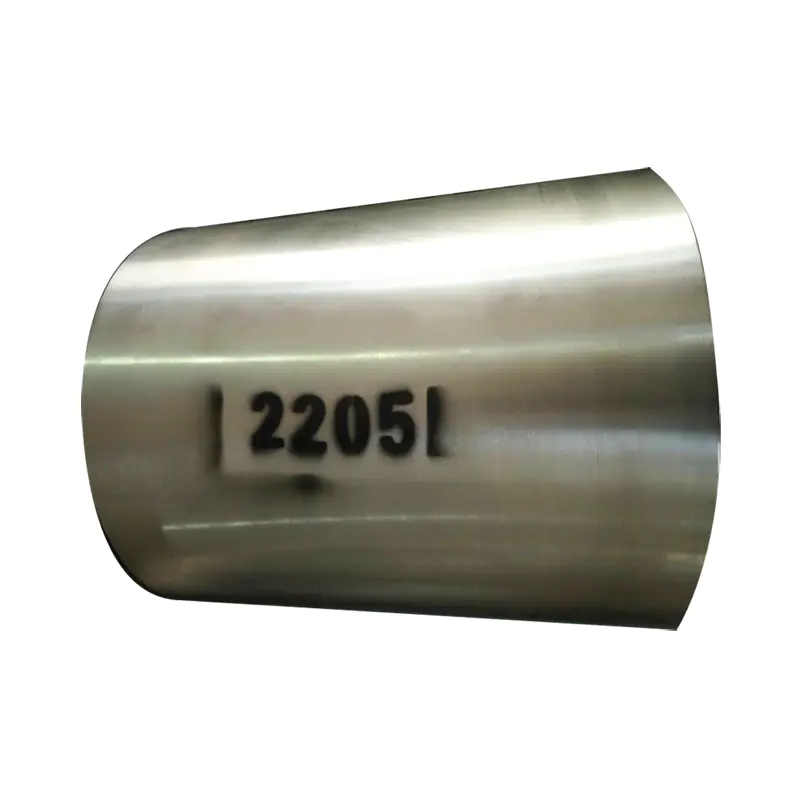 2205 (CD3MN) Corrosion-Resistant Centrifugal-Cast Pump SleevesDuplex 2205 sleeves for water pump and impeller retaining applications offer pitting, chloride and stress-corrosion resistance in corrosive chemical service.View Product →
Three Casting Routes Carry Three Different Cost Structures
Once the grade is settled, the route decides tolerance, surface finish, tooling and the shape of the cost curve. Most stainless casting suppliers run more than one route, and the honest answer to "can you cast this?" is usually "yes, but here is what it costs on each route".
Table 1: Typical capability windows by route; exact limits depend on alloy fluidity, section transitions and gating design.
| Route |
Typical geometry |
Practical wall |
ISO 8062 class |
Tooling |
Best fit |
| Investment (lost wax or lost foam) |
Complex shapes, 0.1-80 kg |
2-8 mm |
DCTG 4-6 |
High |
Valve bodies, impellers, thin-wall fittings |
| Centrifugal |
Tubes and sleeves, OD 50-1000 mm |
8-40 mm |
DCTG 5-7 |
Low to moderate |
Pipe, sleeves, furnace rollers |
| Resin sand |
Large or heavy, low volume |
5 mm and up |
DCTG 6-9 |
Low |
Frames, trays, housings, one-off parts |
Centrifugal casting is the route buyers underestimate most often. The metal is thrown against a rotating mould, so no core is needed for the bore, and the centrifugal force pushes gas and inclusions inward where they can be machined away. That gives a dense wall and a sound outer surface on parts up to 4000 mm long, but the bore side still needs machining allowance and the process suits round sections only. The centrifugal casting process is therefore the natural fit for sleeves and rollers, not for a bracket with three cored ports.
Centrifugal Cast Stainless Steel Pipe and Custom SleevesBrowse custom centrifugal-cast stainless pipe and sleeve variants, including 2205 and 316L, with diameters to 1000 mm and lengths up to 4000 mm.View Product →
Wall Thickness and Machining Stock Move the Price More Than the Alloy
Two quotes for the same drawing frequently differ by 30 percent or more, and the alloy is rarely the reason. The difference sits in how much metal is poured versus how much ships, and how much of it has to be cut away afterwards.
- Minimum wall. Alloy fluidity sets the floor. A 3 mm wall in CF8M is routine for investment casting and risky for sand casting, where core shift of 1-2 mm can leave a section at 2 mm.
- Machining allowance. Three to six millimetres is normal on machined faces. On a 300 mm bore sleeve, a 4 mm radial allowance removes several kilograms per piece, and that weight was paid for at the melt.
- Yield. Risers and gating can account for 30-50 percent of poured weight on a heat-resistant tray. A foundry that redesigns the feeder system rather than the part is often the one with the lower quote.
- Section transitions. An isolated heavy node next to a thin rib concentrates shrinkage porosity exactly where the drawing gives no room for it.
 316L (CF3M) Centrifugal-Cast Anti-Corrosion Pump Sleeves316L sleeves for water pump and impeller retaining service resist acids, alkalis, seawater, chlorides, pitting and stress corrosion in chemical and mineral-liquid environments.View Product →
What Belongs on the Drawing and the Purchase Order
Castings fail on paperwork more often than on metallurgy. These six items remove most of the ambiguity before the first pattern is mounted:
- Grade plus governing standard — for example ASTM A351 for austenitic and duplex, A890 for duplex, A297 for heat-resistant grades, or EN 10295. A trade name alone is not a specification.
- Heat treatment condition — solution anneal and quench for austenitic and duplex grades; quench and temper with a stated hardness window for martensitic grades. "Annealed" on its own means different things in different shops.
- Test bar location and orientation, because mechanical properties change with section size and solidification direction.
- Non-destructive testing — method, coverage and acceptance level. Dye penetrant on sealing faces, radiography on critical sections, ultrasonic inspection on heavy-wall duplex.
- Weld repair policy, including whether any repair is permitted without written approval and how it must be recorded.
- Dimensional report with a datum scheme, plus a 3D scan for free-form or thin-wall parts.
Verification matters as much as specification. A direct-reading spectrometer on each heat confirms chemistry, metallography confirms phase balance in duplex and carbide distribution in martensitic grades, and 3D scanning catches the core shift that a calliper check misses.
Purchasing Risks Worth Writing Into the Contract
- Silent grade substitution. CF8 supplied against a CF3M order looks identical on the bench. Verify with a spectrometer on the delivered part, not only on the mill certificate.
- A skipped solution anneal. Austenitic castings that cool slowly through the sensitisation range lose grain-boundary chromium and corrode early, even though hardness and chemistry look correct.
- Undisclosed weld repair on a pressure-retaining section, which later shows up as a leak path rather than a dimensional defect.
- Hardness shortfall on 440C. Below roughly 58 HRC, the wear rate in an abrasive duty climbs quickly, so specify and verify the hardness window.
- Tolerance stack on press fits. A sleeve at the top of its bore tolerance and a shaft at the top of its own leave no interference, and the joint fails in service rather than at assembly.
None of this is exotic. Stainless steel casting gets expensive when the alloy, the route and the machining allowance are chosen separately by three different people who never look at the failure the part is meant to survive. Write the damage mechanism down, pick the grade to match it, confirm the route can hold the wall thickness, then compare quotes on identical specifications. The number that matters is not the price per kilogram at the foundry gate; it is the cost per year of the component staying in service.




 English
 Español
 عربى